
Written Exercise
You will play the role of a fast streamer overseeing a project. You will have 55 minutes to review information and complete 5 written tasks.
We are looking for your ability to:
- analyse information critically while considering its wider context
- identify issues and explain priorities
- communicate your thoughts clearly and succinctly using the template you are given
You do not need specialist knowledge of the policy area. All the information you need will be provided on the day.
This exercise shares the same overarching theme as the Oral Briefing Exercise, but the exercises are marked independently.
What we’re looking for
We assess your potential across 4 dimensions: Think, Relate, Adapt, and Strive.
Think: How you gather, process and analyse information.
We look for your ability to look beyond your immediate task to notice patterns and how different ideas connect.
This dimension is about how you consider the wider impact of your work.
Relate: Your interpersonal skills and emotional intelligence.
We look at how you manage your emotions, engage with others, communicate effectively and contribute to teamwork.
This dimension is about collaboration, whilst fostering inclusivity and valuing diverse perspectives.
Adapt: Your flexibility and learning agility
We look at how you navigate change, apply new information quickly to solve problems and suggest fresh approaches as things evolve.
This dimension is about being agile and thinking outside the box.
Strive: Your drive and values
We look for passion, resilience in tough situations and commitment to owning your work.
This dimension is about how you stay focused on your goals and turn setbacks into a positive learning experience.
How to prepare
You do not need to prepare extensively, as all the materials you need will be provided on the day.
To familiarise yourself with the process, you can:
- review the example Written Exercise
- practise identifying main risks and goals in news articles or reports within a 55-minute time limit
- look at project plans or team surveys to see how different pieces of information fit together
- practise adjusting your writing style for different audiences, such as senior managers who need a concise update or team members who need a supportive tone
- seek feedback from various sources on your written work to refine your skills.
Tips for the day
- Create a focused environment: Find somewhere quiet with a comfortable temperature and a suitable workspace.
- Manage your time: You may want to spend 20 minutes reviewing the pack and 35 minutes writing your responses – whatever works best for you.
- Use the materials provided: Focus on the scenario in the brief. Try not to use external knowledge or real-world issues and developments.
- Be clear: use bullet points and short paragraphs to get your point across. Remember, your goal is to inform and influence the reader.
- Analyse critically: uncover key patterns within the data, navigate the conflicting opinions and complexities, and deliver a balanced, evidence-based response.
Important: You will receive a template in Microsoft Word via email. Ensure you can access your email account before you begin.
Example of the Written Exercise
Here is an example of the exercise – however, the actual exercise will have different content.
Title: Engaging the Future: Policies to increase participation and create opportunity for those under 30
Background context
It is July 2026. You are a new fast streamer in the Department for Intergenerational Fairness. This Department advises, evaluates, proposes, and supports the implementation of policies ensuring that all generations benefit from government actions.
There is an acknowledgment that younger generations, particularly those born since 1996, have not benefited as much from UK policies as have previous generations. They vote less, have less wealth, and feel less engaged and supported by society.
The focus on intergenerational fairness will be the overarching theme that will continue into the next FSAC exercise, the Stakeholder Communication Exercise. Though thematically linked, each of these two exercises are scored independently.
Specific scenario for the Written Advice Exercise
If voter turnout is a measure of democratic health, the UK faces a challenge. Globally, voter numbers have declined since the 1960s. In the UK, younger people (under 30) are particularly less likely to vote, with only 45% participating in the last general election. This trend is more pronounced among those with fewer qualifications and lower socio-economic backgrounds. Low turnout leads to less representative elected institutions.
Various policy initiatives to increase turnout have been tried in other western democracies, with some success, though few have targeted younger voters. Research by the Electoral Commission highlights issues with postal voting, such as fraud and coercion, making it a less viable solution.
Two pilot schemes focusing on young people, including those from lower socio-economic backgrounds, were conducted in Scotland and Wales. The Electoral Commission, an independent body reporting to Parliament, will recommend whether there should be a broader implementation of one, both or neither of these schemes across the UK.
Task
Draft a recommendation to the Chief Executive of the Electoral Commission, addressing:
- Considering the government’s objectives and the available data, how effective was each pilot?
- What would be the pros and cons associated with each option were it to be implemented nationally and what mitigation strategies do you suggest?
- Make a justified recommendation for one of the two options, or if you consider that neither should be implemented, explain why.
Please note: For task 3, the key point is the justification you use for your answer rather than any specific recommendation you make.
The two pilot schemes were:
- Making Your Vote Count (MYVC):This initiative in Scotland aims to encourage participation from groups that typically do not vote.
- Compulsory e-Voting (CeV):This pilot in Wales involves introducing online voting and making it mandatory for all eligible voters.
Pilot Scheme: Making your vote count (MYVC)
In Scotland, before the MYVC trial, only 29% of the 3.99 million potential young voters participated in local and Scottish Parliament elections, despite a 92% registration rate. Inspired by a successful Canadian program, the trial aimed to increase voter participation by raising awareness of civic duties and simplifying the voting process. Over three years, targeted interventions included community education workshops, outreach to students, and direct engagement through community workers, with the broader goal of enhancing civic engagement.
Pilot Scheme: Compulsory e-Voting (CeV)
In Wales, out of 2.3 million potential young voters, 91% were registered, but only 28% participated in the last local and National Assembly elections.
To make voting more accessible, especially for those with disabilities or in remote areas, e-voting was proposed.
The pilot also introduced compulsory voting, inspired by Australia’s successful implementation, with fines for those who did not vote.
There are 8 supporting documents to support you in this task
Item 1: Government’s objectives
The government needs to be sure that the outcome of any electoral changes will not only be effective in increasing voter turnout from all parts of the population, but will also be publicly acceptable, keep down the cost of running elections, and keep electoral fraud to a minimum. A key concern is that further alienation amongst young voters does not occur.
Item 2: Initial results of the pilot
Within the populations in which they were implemented, the results of the pilots suggested that both approaches worked to about the same extent as the other in terms of increasing the proportion of young people who voted.
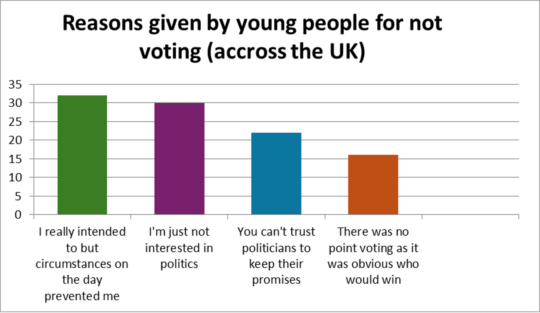
Item 3: Reasons given by young professionals for not voting
Information provided in both graph and table format.
| Reason | Percentage of responders |
|---|---|
| I really intended to but circumstances on the day prevented me | 32 |
| I’m just not interested in politics | 30 |
| You can’t trust politicians to keep to their promises | 22 |
| There was no point voting as it was obvious who would win | 16 |
Item 4: Policy Research & Analysis Unit Costs and Impacts
- The costs for each option differ significantly. Implementing the MYVC project nationally would incur central running costs of £5.6 million over seven years, plus an estimated £7 million annually for outreach programs. Critics argue that the project Head’s salary of £300,000 per year is excessive, but supporters believe it is necessary to attract top talent for success.
- In contrast, the CeV system’s initial setup is projected to cost £600 million in the first year, with average annual running costs of £50 million. While CeV offers potential long-term savings by reducing election administration costs, the high initial investment and ongoing maintenance expenses are considerable.
Item 5: Polling data
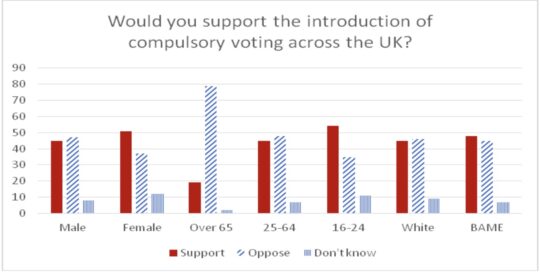
5a: Would you support the introduction of compulsory voting across the UK?
Information provided in graph and table format.
| Category | % Supporting | % Opposing | % Don’t know |
|---|---|---|---|
| Male | 45 | 47 | 8 |
| Female | 51 | 38 | 11 |
| Age: over 65 | 19 | 79 | 2 |
| Age: 25 to 64 | 46 | 48 | 6 |
| Age: 16 to 24 | 54 | 35 | 11 |
| White | 45 | 46 | 11 |
| BAME | 47 | 46 | 7 |
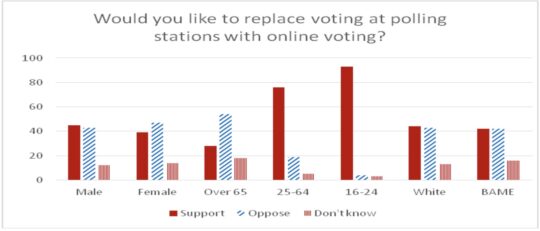
5b: Would you like to replace voting at polling stations with online voting?
Information provided in graph and table format.
| Category | % Supporting | % Opposing | % Don’t know |
|---|---|---|---|
| Male | 44 | 43 | 13 |
| Female | 39 | 48 | 13 |
| Age: over 65 | 29 | 54 | 17 |
| Age: 25 to 64 | 76 | 19 | 5 |
| Age: 16 to 24 | 93 | 4 | 3 |
| White | 44 | 43 | 13 |
| BAME | 41 | 41 | 18 |
5c: Awareness of Pilot scheme “Make your vote count”
Information provided in graph and table format.
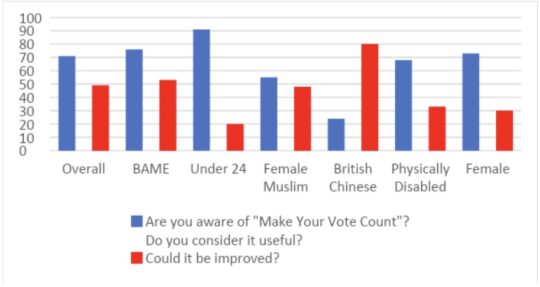
| Category | % responded “yes” to ‘”Are you aware of ‘make your vote count?'” | % responded “yes” to ‘”Do you consider it useful?'” | % responded “yes” to ‘”Could it be improved?'” |
|---|---|---|---|
| Overall | 73 | 52 | 50 |
| BAME | 76 | 63 | 54 |
| Under 24 | 92 | 79 | 20 |
| Female Muslim | 55 | 51 | 48 |
| British Chinese | 23 | 23 | 80 |
| Physically disabled | 68 | 63 | 34 |
| Female | 72 | 75 | 31 |
Item 6: Transcript of a Discussion on “Our World”
Presenter: “Two very different approaches are being trialled in Scotland and Wales; one tries to make people want to become part of the democratic process; the other forces them to do so. We asked San Yuen Wah of the Women in Parliament Group and political analyst Yousaf Atif for their views.”
San Yuen Wah: “Persuasion is always preferable to force. The MYVC initiative encourages more inclusive participation, especially among under-represented groups like ethnic minorities and women. However, there’s a risk that without long-term support, these gains might not be sustained.”
Yousaf Atif: “Compulsory e-voting might seem harsh, but it ensures higher turnout and a more representative democracy. Yet, imposing fines can be controversial and may disproportionately affect lower-income individuals, potentially leading to further disengagement.”
Item 7: Forced Voting – Statement by Leroy Jordan MP, Sarah Walters MP, Rahim Iqbal MP
“We have come together from the three main political parties to express our strong opposition to forced voting. The current experiment in Wales could introduce it to the whole of the UK by the back door. We need to stop it being imposed on the whole country.
The UK is the country of Magna Carta. Voting is a civic right rather than a civic duty. While citizens may exercise their civil rights, such as free speech, they are not compelled to. Compulsory voting tramples on other rights; people should be able to choose not to vote.”
Item 8: The Office for Equal Opportunity and Diversity
The Office for Equal Opportunity and Diversity has provided feedback on two proposed schemes aimed at enhancing democratic participation.
- ‘Making Your Vote Count’ Project: The focus on encouraging non-voters to participate is commendable, promoting full citizenship rights. However, concerns arise from the Scottish experience, where local outreach programs paid on commission led to potential alienation and postal vote fraud. The Office supports the project, provided it avoids coercing or demonising non-voters, ensuring a sensitive approach.
- Compulsory e-Voting: While intended to equalise voting access, compulsory e-voting could disadvantage certain groups. Respecting diverse views and rights, the Office believes citizens should have the choice not to vote. For many, a £100 fine would be a significant burden.